Monday, October 17, 2016

Private Water Wells

If your family gets drinking water from a private well, do you know if your water is safe to drink? What health risks could you and your family face? Where can you go for help or advice? The EPA regulates public water systems; it does not have the authority to regulate private drinking water wells. Approximately 15% of Americans rely on their own private drinking water supplies, and these supplies are not subject to EPA standards, although some state and local governments do set rules to protect users of these wells. Unlike public drinking water 
systems serving many people, they do not have experts regularly checking the water’s source and its quality before it is sent to the tap. These households must take special precautions to ensure the protection and maintenance of their drinking water supplies.
Basic Information
There are three types of private drinking water wells: dug, driven, and drilled. Proper well construction and continued maintenance are keys to the safety of your water supply. Your state water-well contractor licensing agency, local health department, or local water system professional can provide information on well construction. The well should be located so rainwater flows away from it. Rainwater can pick up harmful bacteria and chemicals on the land’s surface. If this water pools near your well, it can seep into it, potentially causing health problems. Water-well drillers and pump-well installers are listed in your local phone directory. The contractor should be bonded and insured. Make certain your ground water contractor is registered or licensed in your state, if required. If your state does not have a licensing/registration program, contact the National Ground Water Association.

To keep your well safe, you must be sure that possible sources of contamination are not close by. Experts suggest the following distances as a minimum for protection — farther is better(see graphic on the right):
  • septic tanks:  50 feet;
  • livestock yards, silos, septic leach fields:  50 feet;
  • petroleum tanks, liquid-tight manure storage and fertilizer storage and handling:  100 feet; and 
  • manure stacks:  250 feet.
Many homeowners tend to forget the value of good maintenance until problems reach crisis-levels. That can be expensive. It’s better to maintain your well, find problems early, and correct them to protect your well’s performance. Keep up-to-date records of well installation and repairs, plus pumping and water tests. Such records can help spot changes and possible problems with your water system. If you have problems, ask a local expert to check your well construction and maintenance records. He or she can see if your system is okay or needs work.
Protect your own well area. Be careful about storage and disposal of household and lawn-care chemicals and wastes. Good farmers and gardeners minimize the use of fertilizers and pesticides. Take steps to reduce erosion and prevent surface water runoff. Regularly check underground storage tanks that hold home heating oil, diesel, or gasoline. Make sure your well is protected from the wastes of livestock, pets and wildlife.
Dug Wells
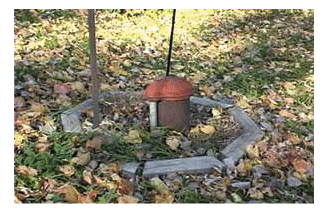
Dug wells are holes in the ground dug by shovel or backhoe. Historically, a dug well was excavated below the ground water table until incoming water exceeded the digger’s bailing rate. The well was then lined (cased) with stones, brick, tile, or other material to prevent collapse. It was covered with a cap of wood, stone or concrete. Since it is so difficult to dig beneath the ground water table, dug wells are not very deep. Typically, they are only 10 to 30 feet deep. Being so shallow, dug wells have the highest risk of becoming contaminated.To minimize the likelihood of contamination, your dug well should have certain features. These features help to prevent contaminants from traveling along the outside of the casing, or through the casing and into the well.
Dug Well Construction Features
  • The well should be cased with a watertight material (for example, tongue-and-groove pre-cast concrete), and a cement grout or bentonite clay sealant poured along the outside of the casing to the top of the well.
  • The well should be covered by a concrete curb and cap that stands about a foot above the ground.
  • The land surface around the well should be mounded so that surface water runs away from the well and is not allowed to pond around the outside of the wellhead.
  • Ideally, the pump for your well should be inside your home or in a separate pump house, rather than in a pit next to the well.
Land activities around a dug well can also contaminate it. While dug wells have been used as a household water supply source for many years, most are relics of older homes, dug before drilling equipment was readily available, or when drilling was considered too expensive. If you have a dug well on your property and are using it for drinking water, check to make sure it is properly covered and sealed. Another problem relating to the shallowness of a dug well is that it may go dry during a drought when the ground water table drops.
Driven Wells  
  
Like dug wells, driven wells pull water from the water-saturated zone above the bedrock. Driven wells can be deeper than dug wells. They are typically 30 to 50 feet deep and are usually located in areas with thick sand and gravel deposits where the ground water table is within 15 feet of the ground’s surface. In the proper geologic setting, driven wells can be easy and relatively inexpensive to install. Although deeper than dug wells, driven wells are still relatively shallow and have a moderate-to-high risk of contamination from nearby land activities.
Driven Well Construction Features
  • Assembled lengths of 2- to 3-inch diameter metal pipes are driven into the ground. A screened “well point” located at the end of the pipe helps drive the pipe through the sand and gravel. The screen allows water to enter the well and filters out sediment.
  • The pump for the well is in one of two places: on top of the well, or in the house. An access pit is usually dug around the well down to the frost line, and a water discharge pipe to the house is joined to the well pipe with a fitting.
  • The well and pit are capped with the same kind of large-diameter concrete tile used for a dug well. The access pit may be cased with pre-cast concrete.
To minimize this risk, the well cover should be a tight-fitting concrete curb and cap with no cracks, and should sit about a foot above the ground. Slope the ground away from the well so that surface water will not pond around the well. If there’s a pit above the well, either to hold the pump or to access the fitting, you may also be able to pour a grout sealant along the outside of the well pipe. Protecting the water quality requires that you maintain proper well construction and monitor your activities around the well. It is also important to follow the same land-use precautions around the driven well as described under dug wells.


Drilled Wells
Drilled wells penetrate about 100 to 400 feet into the bedrock. Where you find bedrock at the surface, it is commonly called ledge. To serve as a water supply, a drilled well must intersect bedrock fractures containing ground water.  
Drilled Well Construction Features
  • The casing is usually metal or plastic pipe, 6 inches in diameter, that extends into the bedrock to prevent shallow ground water from entering the well. By law, the casing has to extend at least 18 feet into the ground, with at least 5 feet extending into the bedrock. The casing should also extend a foot or two above the ground’s surface. A sealant, such as cement grout or bentonite clay, should be poured along the outside of the casing to the top of the well. The well should be capped to prevent surface water from entering the well.
  • Submersible pumps, located near the bottom of the well, are most commonly used in drilled wells. Wells with a shallow water table may feature a jet pump located inside the home. Pumps require special wiring and electrical service. Well pumps should be installed and serviced by a qualified professional registered with your state.
  • Most modern drilled wells incorporate a pitless adapter designed to provide a sanitary seal at the point where the discharge water line leaves the well to enter your home. The device attaches directly to the casing below the frost line, and provides a watertight sub-surface connection, protecting the well from frost and contamination.
  • Older drilled wells may lack some of these sanitary features. The well pipe used was often 8, 10 or 12 inches in diameter, and covered with a concrete well cap either at or below the ground’s surface. This outmoded type of construction does not provide the same degree of protection from surface contamination. Also, older wells may not have a pitless adapter to provide a seal at the point of discharge from the well.
Hydrofracting a Drilled Well
Hydrofracting is a process that applies water or air under pressure into your well to open up existing fractures near your well, and can even create new ones. Often, this can increase the yield of your well. This process can be applied to new wells with insufficient yield and to improve the quantity of older wells.
How can I test the quality of my private drinking water supply? 
Consider testing your well for pesticides, organic chemicals, and heavy metals before you use it for the first time. Test private water supplies annually for nitrate and coliform bacteria to detect contamination problems early. Test them more frequently if you suspect a problem. Be aware of activities in your watershed that may affect the water quality of your well, especially if you live in an unsewered area.
Human Health
The first step to protect your health and the health of your family is learning about what may pollute your source of drinking water. Potential contamination may occur naturally, or as a result of human activity.
What are some naturally occurring sources of pollution?
  • micro-organisms:  Bacteria, viruses, parasites and other microorganisms are sometimes found in water. Shallow wells — those with water close to ground level — are at most risk. Runoff, or water flowing over the land surface, may pick up these pollutants from wildlife and soils. This is often the case after flooding. Some of these organisms can cause a variety of illnesses. Symptoms include nausea and diarrhea. These can occur shortly after drinking contaminated water. The effects could be short-term yet severe (similar to food poisoning), or might recur frequently or develop slowly over a long time.
  • radionuclides: Radionuclides are radioactive elements, such as uranium and radium. They may be present in underlying rock and ground water.
  • radon: Radon is a gas that is a natural product of the breakdown of uranium in the soil and can also pose a threat. Radon is most dangerous when inhaled, and contributes to lung cancer. Although soil is the primary source, using household water containing radon contributes to elevated indoor radon levels. Radon is less dangerous when consumed in water, but remains a risk to health.
  • nitrates and nitrites: Although high nitrate levels are usually due to human activities (see below), they may be found naturally in ground water. They come from the breakdown of nitrogen compounds in the soil. Flowing ground water picks them up from the soil. Drinking large amounts of nitrates and nitrites is particularly threatening to infants (for example, when mixed in formula).
  • heavy metals: Underground rocks and soils may contain arsenic, cadmium, chromium, lead, and selenium. However, these contaminants are not often found in household wells at dangerous levels from natural sources.
  • fluoride: Fluoride is helpful in dental health, so many water systems add small amounts to drinking water. However, excessive consumption of naturally occurring fluoride can damage bone tissue. High levels of fluoride occur naturally in some areas. It may discolor teeth, but this is not a health risk.

What human activities can pollute ground water?

  • Septic tanks are designed to have a leach field around them, which is an area where wastewater flows out of the tank. This wastewater can also move into the ground water.
    bacteria and nitrates: These pollutants are found in human and animal wastes. Septic tanks can cause bacterial and nitrate pollution. So can large numbers of farm animals. Both septic systems and animal manure must be carefully managed to prevent pollution. Sanitary landfills and garbage dumps are also sources. Children and some adults are at higher risk when exposed to waterborne bacteria. These include the elderly and people whose immune systems are weak due to AIDS or treatments for cancer. Fertilizers can add to nitrate problems. Nitrates cause a health threat in very young infants called “blue baby syndrome." This condition disrupts oxygen flow in the blood. 
  • concentrated animal feeding operations (CAFOs): The number of CAFOs, often called “factory farms,” is growing. On these farms, thousands of animals are raised in a small space. The large amounts of animal waste/manure from these farms can threaten water supplies. Strict and careful manure management is needed to prevent pathogen and nutrient problems. Salts from high levels of manure can also pollute ground water. 
  • heavy metals: Activities such as mining and construction can release large amounts of heavy metals into nearby ground water sources. Some older fruit orchards may contain high levels of arsenic, once used as a pesticide. At high levels, these metals pose a health risk. 
  • fertilizers and pesticides: Farmers use fertilizers and pesticides to promote growth and reduce insect damage. These products are also used on golf courses and suburban lawns and gardens. The chemicals in these products may end up in ground water. Such pollution depends on the types and amounts of chemicals used and how they are applied. Local environmental conditions (soil types, seasonal snow and rainfall) also affect this pollution. Many fertilizers contain forms of nitrogen that can break down into harmful nitrates. This could add to other sources of nitrates mentioned above. Some underground agricultural drainage systems collect fertilizers and pesticides. This polluted water can pose problems to ground water and local streams and rivers. In addition, chemicals used to treat buildings and homes for termites and other pests may also pose a threat. Again, the possibility of problems depends on the amount and kind of chemicals. The types of soil and the amount of water moving through the soil also play a role. 
  • industrial products and waste: Many harmful chemicals are used widely in local business and industry. These can pollute drinking water if not well-managed. The most common sources of such problems are:
    • local businesses: These include nearby factories, industrial plants, and even small businesses such as gas stations and dry cleaners. All handle a variety of hazardous chemicals that need careful management. Spills and improper disposal of these chemicals and other industrial wastes can threaten ground water supplies.
    • leaking underground tanks and piping: Petroleum products, chemicals and waste stored in underground storage tanks and pipes may end up in the ground water. Tanks and piping leak if they are constructed or installed improperly. Steel tanks and piping corrode with age. Tanks are often found on farms. The possibility of leaking tanks is great on old, abandoned farm sites. Farm tanks are exempt from the EPA rules for petroleum and chemical tanks.
    • landfills and waste dumps: Modern landfills are designed to contain any leaking liquids. But floods can carry them over the barriers. Older dumpsites may have a wide variety of pollutants that can seep into ground water.
  • household waste: Improper disposal of many common products can pollute ground water. These include cleaning solvents, used motor oil, paints, and paint thinners. Even soaps and detergents can harm drinking water. These are often a problem from faulty septic tanks and septic leaching fields. 
  • lead and copper: Household plumbing materials are the most common source of lead and copper found in home drinking water. Corrosive water may cause metals in pipes or soldered joints to leach into your tap water. Your water’s acidity or alkalinity (often measured as pH) greatly affects corrosion. Temperature and mineral content also affect how corrosive it is. They are often used in pipes, solder and plumbing fixtures. Lead can cause serious damage to the brain, kidneys, nervous system, and red blood cells. The age of plumbing materials — in particular, copper pipes soldered with lead — is also important. Even in relatively low amounts, these metals can be harmful. The EPA rules under the Safe Drinking Water Act limit lead in drinking water to 15 parts per billion. Since 1988, the Act allows only lead-free pipe, solder and flux in drinking water systems. The law covers both new installations and repairs of plumbing.
 What You Can Do...

Private, individual wells are the responsibility of the homeowner. To help protect your well, here are some steps you can take:
Have your water tested periodically. It is recommended that water be tested every year for total coliform bacteria, nitrates, total dissolved solids, and pH levels. If you suspect other contaminants, test for those. Always use a state-certified laboratory that conducts drinking water tests. Since these can be expensive, spend some time identifying potential problems. Consult your InterNACHI inspector for information about how to go about water testing.
Testing more than once a year may be warranted in special situations if:
  • someone in your household is pregnant or nursing;
  • there are unexplained illnesses in the family;
  • your neighbors find a dangerous contaminant in their water;
  • you note a change in your water's taste, odor, color or clarity;
  • there is a spill of chemicals or fuels into or near your well; or 
  • you replace or repair any part of your well system.

Identify potential problems as the first step to safe-guarding your drinking water. The best way to start is to consult a local expert -- someone who knows your area, such as the local health department, agricultural extension agent, a nearby public water system, or a geologist at a local university.


Be aware of your surroundings. As you drive around your community, take note of new construction. Check the local newspaper for articles about new construction in your area.
Check the paper or call your local planning and zoning commission for announcements about hearings or zoning appeals on development or industrial projects that could possibly affect your water.


Attend these hearings, ask questions about how your water source is being protected, and don't be satisfied with general answers.  Ask questions, such as:  "If you build this landfill, what will you do to ensure that my water will be protected?" See how quickly they answer and provide specifics about what plans have been made to specifically address that issue.

Identify Potential Problem Sources

To start your search for potential problems, begin close to home. Do a survey around your well to discover:
  • Is there livestock nearby?
  • Are pesticides being used on nearby agricultural crops or nurseries?
  • Do you use lawn fertilizers near the well?
  • Is your well downstream from your own or a neighbor's septic system?
  • Is your well located near a road that is frequently salted or sprayed with de-icers during winter months?
  • Do you or your neighbors dispose of household waste or used motor oil in the backyard, even in small amounts?
If any of these items apply, it may be best to have your water tested and talk to your local public health department or agricultural extension agent to find ways to change some of the practices which can affect your private well.
In addition to the immediate area around your well, you should be aware of other possible sources of contamination that may already be part of your community or may be moving into your area. Attend any local planning or appeals hearings to find out more about the construction of facilities that may pollute your drinking water. Ask to see the environmental impact statement on the project. See if the issue of underground drinking water sources has been addressed. If not, ask why.

Common Sources of Ground Water Contamination

Category       Contaminant Source
Agricultural
  • animal burial areas
  • drainage fields/wells
  • animal feedlots
  • irrigation sites
  • fertilizer storage/use
  • manure spreading areas/pits, lagoons
  • pesticide storage/use
Commercial
  • airports
  • jewelry/metal plating
  • auto repair shops
  • laundromats
  • boat yards
  • medical institutions
  • car washes
  • paint shops
  • construction areas
  • photography establishments
  • cemeteries
  • process waste-water drainage
  • dry cleaners fields/wells
  • gas stations
  • railroad tracks and yards
  • golf courses
  • research laboratories
  • scrap and junkyards
  • storage tanks
Industrial
  • asphalt plants
  • petroleum production/storage
  • chemical manufacture/storage
  • pipelines
  • electronic manufacture
  • process waste-water drainage
  • electroplaters fields/wells
  • foundries/metal fabricators
  • septage lagoons and sludge
  • machine/metalworking shops
  • storage tanks
  • mining and mine drainage
  • toxic and hazardous spills
  • wood-preserving facilities
Residential
  • fuel oil
  • septic systems, cesspools
  • furniture stripping/refinishing
  • sewer lines
  • household hazardous products
  • swimming pools (chemicals)
  • household lawns
Other
  • hazardous waste landfills
  • recycling/reduction facilities
  • municipal incinerators
  • road de-icing operations
  • municipal landfills
  • road maintenance depots
  • municipal sewer lines
  • Storm water drains/basins/wells
  • open burning sites
  • transfer stations

To have your San Antonio, TX area well water checked, contact us at www.vhillc.com

Sunday, October 16, 2016

USDA Loans

A bit of information about a loan type that many people have never heard of.

USDA loans are housing loans that are backed through the Rural Housing Division of the U.S. Department of Agriculture (USDA).

The USDA offers competitive loans for borrowers in rural areas
 
 
Purpose
 
In the wake of the mortgage crisis in 2008 and 2009, lenders have become more cautious, so it's harder for home buyers, especially first-timers, to secure financing, especially those with low incomes or little money for a down payment. In response, the USDA has enacted changes that made millions of borrowers eligible for their rural mortgage programs, which have been around for decades. These loans are primarily used to help low-income individuals and families purchase homes in rural areas, given the challenges faced in finding an affordable mortgage loan or deriving high income in sparsely populated areas. Funds can be used to build, repair, renovate or relocate a home, or to purchase and prepare sites, including providing water and sewage facilities. If the borrower defaults on payments, loan funds are still guaranteed to the lender.
 
 
Eligibility of Applicants
 
The following factors affect eligibility for USDA loans:
  • Loans are restricted to borrowers in rural areas, although many of the zip codes that qualify for USDA loans are in relatively typical suburbs of major cities.  The 2002 Farm Bill defines a rural area as "any area other than (1) a city or town that has a population of greater than 50,000 inhabitants, and (2) the urbanized areas contiguous and adjacent to such a city or town."
  • Applicants for loans may have an income of up to 115% of the median income for the area. If an income exceeds the maximum mark, you may be able to make certain adjustments that will help you qualify.
  • Applicant families must currently be without adequate housing, but be able to afford the mortgage payments, including taxes and insurance. Copies of IRS tax filings from years prior may be required, especially if the prospective borrower is self-employed or has worked many jobs over the past few years.
  • Applicants must have reasonable credit histories. Late payments will appear on the credit history, as will bankruptcies, repossessions and  foreclosures.
  • The amount loaned will also depend on the number of dependents claimed by the applicant.
 
Eligibility of Housing
 
Housing must be modest in size, design and cost. Also, houses constructed, purchased or rehabilitated must meet the building code adopted by the state and the Housing and Community Facilities Programs' (HCFP) thermal and site standards. New manufactured housing must be permanently installed and meet the manufactured housing construction and safety standards of the U.S. Department of Housing and Urban Development (HUD), as well as the HCFP's thermal and site standards.  Existing manufactured housing may not qualify unless it is already financed with an HCFP direct or guaranteed loan, or it is Real Estate-Owned (REO), formerly secured by an HCFP direct or guaranteed loan.
 
 
USDA Loans vs. Federal Housing Authority (FHA) Loans
 
While the USDA and FHA both insure loans made by private lenders, the policies and eligibility requirements for each are quite different. The following are the principle differences:
  • Unlike loans offered by the FHA, USDA loans have no monthly mortgage insurance premium.
  • The FHA requires that an applicant invest 3.5% of the purchase price as a down payment, although this fee may be donated by an employer, a blood relative, or a non-profit organization that is approved by HUD.  The USDA does not require a down payment.
  • Both the USDA and FHA have similar appraisal requirements.  Both feature mortgage options for a fixed rate mortgage, and repayment terms of 15 years and 30 years.
  • FHA loans may be as high as $729,750, while USDA loans are limited to $300,000.
 
In summary, USDA loans are a good option for many prospective home buyers and borrowers living in (or moving to) rural areas.

For more information on the USDA mortgage program, visit their page.

Don't forget to contact Veteran Home Inspections to have that new house inspected!

by Nick Gromicko

Used with permission from https://www.nachi.org/usda-loans.htm

Saturday, October 15, 2016

Carbon Monoxide Poisoning and Detectors

Carbon Monoxide detectors, or the lack thereof, is one of the most common defects I find during a home inspection!


Carbon monoxide (CO) is a colorless, odorless, poisonous gas that forms from incomplete combustion of fuels, such as natural or liquefied petroleum gas, oil, wood or coal.
 
Facts and Figures
  • 480 U.S. residents died between 2001 and 2003 from non-fire-related carbon-monoxide poisoning.
  • Most CO exposures occur during the winter months, especially in December (including 56 deaths, and 2,157 non-fatal exposures), and in January (including 69 deaths and 2,511 non-fatal exposures). The peak time of day for CO exposure is between 6 and 10 p.m.
  • Many experts believe that CO poisoning statistics understate the problem. Because the symptoms of CO poisoning mimic a range of common health ailments, it is likely that a large number of mild to mid-level exposures are never identified, diagnosed, or accounted for in any way in carbon monoxide statistics.
  • Out of all reported non-fire carbon-monoxide incidents, 89% or almost nine out of 10 of them take place in a home.
Physiology of Carbon Monoxide Poisoning
When CO is inhaled, it displaces the oxygen that would ordinarily bind with hemoglobin, a process the effectively suffocates the body. CO can poison slowly over a period of several hours, even in low concentrations. Sensitive organs, such as the brain, heart and lungs, suffer the most from a lack of oxygen.
High concentrations of carbon monoxide can kill in less than five minutes. At low concentrations, it will require a longer period of time to affect the body. Exceeding the EPA concentration of 9 parts per million (ppm) for more than eight hours may have adverse health affects. The limit of CO exposure for healthy workers, as prescribed by the U.S. Occupational Health and Safety Administration, is 50 ppm.
 
Potential Sources of Carbon Monoxide

Any fuel-burning appliances which are malfunctioning or improperly installed can be a source of CO, such as:
  • furnaces;
  • stoves and ovens;
  • water heaters;Cars should never be left running in a garage
  • dryers; 
  • room and space heaters; 
  • fireplaces and wood stoves;
  • charcoal grills;
  • automobiles;
  • clogged chimneys or flues;
  • space heaters;
  • power tools that run on fuel;
  • gas and charcoal grills;
  • certain types of swimming pool heaters; and 
  • boat engines.


PPM
% CO 
in air
Health Effects in Healthy Adults
Source/Comments
0
0%
no effects; this is the normal level in a properly operating heating appliance

35
0.0035%
maximum allowable workplace exposure limit for an eight-hour work shift
The National Institute for Occupational Safety and Health (NIOSH)
50
0.005%
maximum allowable workplace exposure limit for an eight-hour work shift
              OSHA
100
0.01%
slight headache, fatigue, shortness of breath, 
errors in judgment

125
0.0125%

workplace alarm must sound (OSHA)
200
0.02%
headache, fatigue, 
nausea, dizziness

400
0.04%
severe headache, fatigue, nausea, dizziness, confusion; can be life-threatening after three hours of exposure
evacuate area immediately
800
0.08%
convulsions, loss of consciousness;
death within three hours
evacuate area immediately
12,000
1.2%
nearly instant death


CO Detector Placement

CO detectors can monitor exposure levels, but do not place them:
  • directly above or beside fuel-burning appliances, as appliances may emit a small amount of carbon monoxide upon start-up;
  • within 15 feet of heating and cooking appliances, or in or near very humid areas, such as bathrooms;
  • within 5 feet of kitchen stoves and ovens, or near areas locations where household chemicals and bleach are stored (store such chemicals away from bathrooms and kitchens, whenever possible);
  • in garages, kitchens, furnace rooms, or in any extremely dusty, dirty, humid, or greasy areas;
  • in direct sunlight, or in areas subjected to temperature extremes. These include unconditioned crawlspaces, unfinished attics, un-insulated or poorly insulated ceilings, and porches;
  • in turbulent air near ceiling fans, heat vents, air conditioners, fresh-air returns, or open windows. Blowing air may prevent carbon monoxide from reaching the CO sensors.
Do place CO detectors:
  • within 10 feet of each bedroom door and near all sleeping areas, where it can wake sleepers. The Consumer Product Safety Commission (CPSC) and Underwriters Laboratories (UL) recommend that every home have at least one carbon monoxide detector for each floor of the home, and within hearing range of each sleeping area;
  • on every floor of your home, including the basement (source:  International Association of Fire Chiefs/IAFC);
  • near or over any attached garage. Carbon monoxide detectors are affected by excessive humidity and by close proximity to gas stoves (source:  City of New York);
  • near, but not directly above, combustion appliances, such as furnaces, water heaters, and fireplaces, and in the garage (source:  UL); and
  • on the ceiling in the same room as permanently installed fuel-burning appliances, and centrally located on every habitable level, and in every HVAC zone of the building (source:  National Fire Protection Association 720). This rule applies to commercial buildings.
In North America, some national, state and local municipalities require installation of CO detectors in new and existing homes, as well as commercial businesses, among them:  Illinois, Massachusetts, Minnesota, New Jersey, Vermont and New York City, and the Canadian province of Ontario. Installers are encouraged to check with their local municipality to determine what specific requirements have been enacted in their jurisdiction.
How can I prevent CO poisoning?
  • Purchase and install carbon monoxide detectors with labels showing that they meet the requirements of the new UL standard 2034 or Comprehensive Safety Analysis 6.19 safety standards.
  • Make sure appliances are installed and operated according to the manufacturer's instructions and local building codes. Have the heating system professionally inspected by an InterNACHI inspector and serviced annually to ensure proper operation. The inspector should also check chimneys and flues for blockages, corrosion, partial and complete disconnections, and loose connections.
  • Never service fuel-burning appliances without the proper knowledge, skill and tools. Always refer to the owner's manual when performing minor adjustments and when servicing fuel-burning equipment.
  • Never operate a portable generator or any other gasoline engine-powered tool either in or near an enclosed space, such as a garage, house or other building. Even with open doors and windows, these spaces can trap CO and allow it to quickly build to lethal levels.
  • Never use portable fuel-burning camping equipment inside a home, garage, vehicle or tent unless it is specifically designed for use in an enclosed space and provides instructions for safe use in an enclosed area.
  • Never burn charcoal inside a home, garage, vehicle or tent.
  • Never leave a car running in an attached garage, even with the garage door open.
  • Never use gas appliances, such as ranges, ovens or clothes dryers to heat your home.
  • Never operate un-vented fuel-burning appliances in any room where people are sleeping.
  • During home renovations, ensure that appliance vents and chimneys are not blocked by tarps or debris. Make sure appliances are in proper working order when renovations are complete.
  • Do not place generators in the garage or close to the home. People lose power in their homes and get so excited about using their gas-powered generator that they don't pay attention to where it is placed. The owner's manual should explain how far the generator should be from the home.
  • Clean the chimney. Open the hatch at the bottom of the chimney to remove the ashes.  Hire a chimney sweep annually.
  • Check vents. Regularly inspect your home's external vents to ensure they are not obscured by debris, dirt or snow.
 

In summary, carbon monoxide is a dangerous poison that can be created by various household appliances. CO detectors must be placed strategically throughout the home or business in order to alert occupants of high levels of the gas.

For more information, contact us at www.vhillc.com

by Nick Gromicko
Used with permission from https://www.nachi.org/carbon-monoxide.htm

Friday, October 14, 2016

Buying a Foreclosure

Purchasing foreclosed homes in desirable areas at below-market values can be a sound investment strategy. Appreciation on their original prices may be tax-free.  Buying foreclosed rental properties can provide positive cash flow, as well as valuable tax deductions. On the other hand, buying a foreclosure involves homework, patience, and a certain amount of luck. For those wishing to get a bargain house through the foreclosure process, it’s best to learn the basics.

Foreclosed homes are often sold at auction
 
Four Ways to Buy a Foreclosed Home
  • presale is when the prospective buyer negotiates with the current owner before the house is foreclosed upon. Presale discounts can be considerable, but communicating and reasoning with the owner isn’t always easy; they might have legal problems, lost their phone service or electricity, or greet you with suspicion, having already been hounded and threatened by creditors. And after time and energy have been invested, the deal can fall through if the owner comes up with the money to repay their debt, or for any number of unexpected reasons. With persistence, however, the seasoned real estate investor can profit from presales. To find out about presales, you can try one of the following avenues:
    • Ask your local county court how to search new notices of default.
    • Find out if the County Recorder has data available online.
    • Look in the "legal notices" section of the newspaper for properties that are coming up for sale at public auction. Take note of the address, the property owner’s name, the tax ID, and whatever other information is contained in the ad.
  • A foreclosed home may be sold at a public auction, in which buyers can expect a discount of 10% to 25% of market value. Interested bidders are generally required to show proof of financing, and must have a minimum cash deposit before they are qualified to bid. It might be impossible to gain entry to inspect the interior, too, which makes this type of purchase risky. The local building department may have permit records that can clue you in to the building’s layout and appearance.
  • real estate-owned (REO) sale is a transaction where a foreclosed house is purchased directly from the bank. These properties typically wound up in the bank’s portfolio after failing to sell at auction. REO investments are relatively safe, as there are no tenants to evict or hidden liens and, unlike properties sold at public auction, buyers can usually receive a mortgage to pay for them. And purchasers might even get an unused house; the slow economy has left many builders at the end of their construction-loan periods without finding buyers for the homes, in which case the bank will foreclose on the brand new homes. Unfortunately, REOs are usually offered at near-market prices to recoup the costs of property taxes, maintenance and legal fees. To find REOs, try the following:
    • Check lenders’ websites, as they may have a list of their REOs, along with contact information for the appropriate real estate agent.
    • Call lenders and ask to speak to someone who handles their foreclosures.
    • Check newspapers.
  • The Department of Housing and Urban Development has tens of thousands of HUD homes whose previous owners defaulted on federally issued loans. After a period during which local governments gain exclusive buying privileges, they become available to individual buyers who pledge to live in the property. After another 10 days, investors may bid on the property. It’s difficult to make a profit on these houses, as HUD releases them at near-market values.
Tips for Foreclosure Purchases
  • Invest time in research and preparation. Those new to the field should spend some time learning the variables of foreclosure investing before making any purchases.
  • Budget carefully to prepare for the unexpected. The house may require unforeseen repairs, such as a leaky roof or unstable deck. The price tag of the home itself is often just the first of a series of fees. What if you planned on rental cash flow to cover the mortgage, but you can’t find a tenant?
  • Avoid buying a foreclosure sight-unseen. Try to see the house yourself before buying it, or hire someone to evaluate at it in your absence. Distant investors are buying up properties unseen in bulk, and they’re often unpleasantly surprised at how much they’ve been misled.
  • Evaluate the neighborhood. If the foreclosure is rife with problems, but it’s in a desirable area with high property resale values, it may still be worth it to make a low offer. An area with several foreclosures or a high crime rate can undermine an otherwise good deal, however.
  • Consider how long the house has been vacant. Building damage – and the costs required to make the house livable - generally increases with the time that has lapsed since the last tenant vacated. Pests are a particular issue in houses that have been empty for a long time, and plumbing defects and leaks increase in likelihood in such homes, as well.
  • Examine the landscaping. Left unchecked, trees can send their roots into the foundation, and vines can creep into the windows.
  • Has the house been professionally inspected by an InterNACHI inspector? Foreclosures can be notorious for damage suffered at the hands of past tenants, through both inadvertent and intentional vandalism and theft.

In summary, there are a number of ways to go about buying a foreclosed home, and buyers should exercise patience, persistence and careful planning before buying foreclosed properties.

To have a Certified Master Inspector examine a foreclosure you are thinking of purchasing, contact www.vhillc.com

by Nick Gromicko  
Used with permission from https://www.nachi.org/buying-foreclosure.htm