Showing posts with label energy savings. Show all posts

Saturday, June 20, 2026

Is Your HVAC Trying to Kill Your Comfort? The Hidden Dangers of Improperly Sized Systems

 A high-quality professional photograph of a modern HVAC condenser unit outside a Texas Hill Country home.

In the scorching heat of a San Antonio summer, your HVAC system isn’t just a luxury: it’s a life-support system for your home’s comfort and structural integrity. However, many homeowners in the Texas Hill Country are living with a ticking time bomb: an improperly sized HVAC system. Whether your unit is too big, too small, or a "Frankenstein" creation of mismatched parts, the consequences go far beyond a high electric bill.

At Veteran Home Inspections, we frequently encounter systems that were installed based on "rules of thumb" rather than precise calculations. Michael Marlow’s extensive background in home inspections and mold assessment provides our team with a unique perspective on how these systems should be integrated into a home’s design and installation. We understand that an HVAC system is not a standalone appliance; it is the heart of your home’s climate control. When that heart is the wrong size, the entire "body" of your home suffers.

The Myth of "Bigger is Better": The Oversized HVAC

Many homeowners assume that a larger air conditioner will cool their home faster and more effectively. This is a dangerous misconception. In a climate like San Antonio, where humidity levels often rival those of a tropical rainforest, an oversized HVAC system is one of the primary causes of indoor discomfort.

The "Cold and Clammy" Phenomenon

An oversized unit cools your home too quickly. It reaches the temperature set on your thermostat in a matter of minutes and then shuts off. This is known as short cycling. While the air might feel 72°F, the system hasn't run long enough to perform its second, more critical job: removing excess moisture from the air.

Air conditioning coils need time to get cold enough to pull moisture out of the air. When a system short-cycles, it leaves the humidity levels hovering at 60% or higher. This creates that unpleasant "cold and clammy" feeling where you’re shivering but your skin feels sticky.

Accelerated Wear and Energy Spikes

Every time your HVAC motor starts up, it consumes a massive surge of electricity: far more than it uses while running steadily. Frequent starting and stopping (short cycling) leads to:

  • Higher Energy Bills: You are paying for the "startup cost" of your AC dozens of times a day.
  • Premature Component Failure: The constant mechanical stress on the compressor and fan motors can cut the lifespan of your system in half.
  • Uneven Temperatures: Rooms furthest from the thermostat often remain warm because the system shuts off before the cooled air can circulate properly.

A digital hygrometer showing high humidity and low temperature inside a home with visible window condensation.

The Little Engine That Couldn't: The Undersized HVAC

On the opposite end of the spectrum is the undersized system. This usually happens when a home has been expanded or when an installer tries to save money by putting in a smaller unit than the home’s square footage and heat load require.

The Perpetual Run Time

An undersized unit will run almost continuously during a San Antonio afternoon. Because it lacks the capacity to move enough heat out of the house, the temperature inside will slowly climb despite the AC running at full blast. This leads to:

  • Extreme Energy Consumption: Because the unit never reaches the setpoint, it never shuts off, leading to skyrocketing utility costs.
  • Component Burnout: HVAC systems are not designed to run 24/7 at peak capacity. This leads to overheated motors and seized compressors.
  • Poor Air Filtration: When a system is constantly struggling, airflow can become stagnant in certain areas of the house, leading to poor indoor air quality.

The "Frankenstein" Mismatch: Different Tonnage Ratings

Perhaps the most technical: and most overlooked: hazard is a mismatch between the indoor evaporator coil and the outdoor compressor (condenser). This often occurs during "partial" replacements where a contractor replaces an outdoor unit but leaves the old indoor coil to save the homeowner money. Builders also often use mismatched sizing to cheat the home energy rating score they need to get tax credits. They save, and you will pay in the future, sometimes very quickly.

Efficiency and Warranty Violations

HVAC components are engineered to work as a matched set. When you pair a 3-ton outdoor unit with a 2.5-ton indoor coil, or vice versa, you create a "Frankenstein" system that underperforms in every category.

  1. Humidity issues: When the evaporator coil is larger than the compressor, this can make the system more efficient, at least when it comes to energy consumption. However, this is not a good thing for your indoor environment. By making the system more efficient, we run into the same problems we see with an oversized unit. The system satisfies the thermostat too fast, leading to short-cycling and skyrocketing humidity in the house.
  2. Warranty Voids: Most manufacturers will not honor a warranty if the indoor and outdoor units are not AHRI-matched. If your brand-new compressor fails, you may be stuck with the full bill because the components didn't match.
  3. Refrigerant Issues: Proper refrigerant charging is nearly impossible in a mismatched system, leading to liquid "slugging" that can destroy the compressor.

A home inspector examining the data plate on an HVAC unit with a flashlight to verify tonnage and matching components.

The Humidity Connection: Why Sizing is a Health Issue

In the Texas Hill Country, humidity isn't just about comfort; it's about health. When an improperly sized system fails to control moisture, your home becomes a breeding ground for mold and mildew.

As a Certified Master Inspector in San Antonio, we have seen firsthand how high humidity levels (anything consistently above 50% RH) lead to:

  • Mold Growth: Mold spores thrive on organic materials like drywall and wood when moisture is present.
  • Musty Odors: That "old house smell" is often the off-gassing of microbial growth fueled by poor dehumidification.
  • Respiratory Issues: Dust mites and mold allergens are significantly more prevalent in humid environments, exacerbating asthma and allergies.
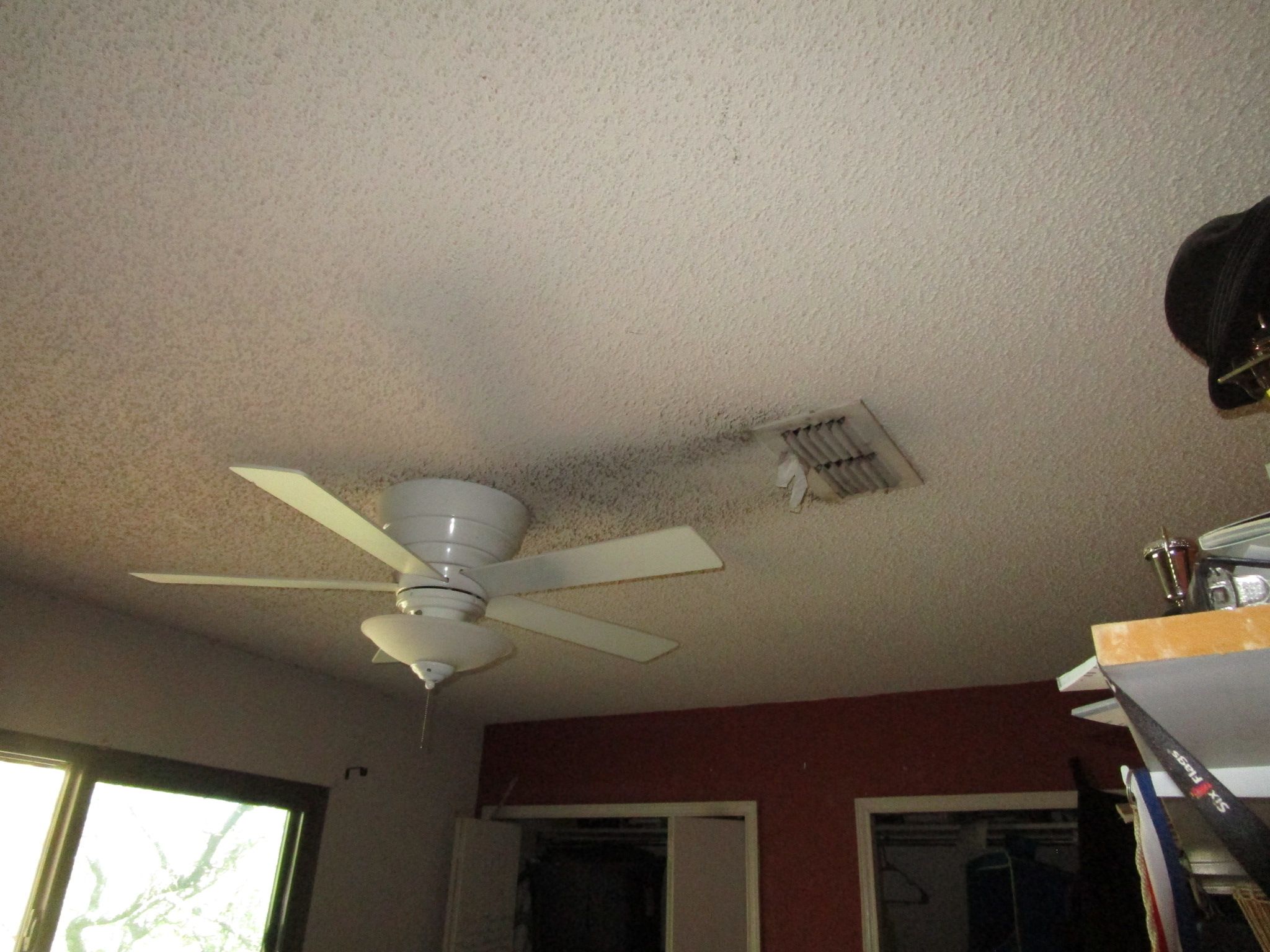
Visible black mold staining around an HVAC vent on a bedroom ceiling due to moisture issues.

What a Certified Master Inspector Looks For

During a professional home inspection in San Antonio, the inspectors at Veteran Home Inspections don't just check if the air coming out is cold. We perform a comprehensive evaluation of the system’s health and sizing.

1. Data Plate Verification

We check the data plates on both the indoor and outdoor units. We verify that the tonnage ratings match and that the equipment is compatible. If we see a 2024 condenser paired with a 2012 evaporator coil, we flag it as a significant concern for both efficiency and warranty coverage. We don't conduct the actual sizing calculations, as that requires extensive specialized training, so if we suspect an improperly sized unit we will refer you to an HVAC specialist to get these calculations done.

2. Temperature Differentials (Delta-T)

We measure the temperature difference between the return air and the supply air. A properly functioning, correctly sized system should generally have a "split" of 15 to 22 degrees. If the split is too low, the system is struggling; if it’s too high, you may have airflow restrictions or sizing issues.

3. Thermal Imaging

We utilize advanced thermal imaging inspections to see what the naked eye cannot. We check for "hot spots" in rooms that might indicate poor duct design or an undersized unit. We also look for cold spots on walls or ceilings that could indicate hidden condensation and potential mold growth.

4. Signs of High Humidity

We look for secondary evidence of sizing issues, such as:

  • Condensation on windows or air vents.
  • Rusting on the HVAC cabinet or surrounding components.
  • Musty odors or visible microbial growth in the air handler closet and around vents.

An inspector using a thermal imaging camera to check the temperature of an HVAC vent.

Protect Your Investment and Your Health

Your home is likely your largest investment. Don't let an improperly sized HVAC system quietly destroy its value, your comfort, and your health. Whether you are buying a new home in Boerne or selling a property in San Antonio, a professional inspection is the only way to ensure your climate control system is working for you, not against you.

If you suspect your HVAC system is short cycling, failing to keep up, or leaving your home feeling clammy, it’s time for a professional evaluation. Veteran Home Inspections provides the expert insight you need to make informed decisions about your property.

Don’t wait until the next Texas heat wave to find out your system isn’t up to the task.

Contact Veteran Home Inspections today at 210-202-1974 or schedule your inspection online.

Tuesday, September 26, 2017

FREE Real Estate Agent Online Continuing Education

     Attention Texas Real Estate Agents!  Like you, I understand the chore of having to do continuing education.  What's even worse is having to pay someone else to take these courses just to maintain your license.  Because of this, I'm happy to be able to offer you a free course for 2 approved CE credits.  This course, Home Energy Score for Real Estate Professionals, is a great course that will teach you about the Home Energy Score program, and how you can use it to help your clients.

     To access the course, go to www.nachi.org/agentce and select Texas.  When it asks you for the ID of the NACHI inspector that referred you, enter NACHI14020415.  

     Once you've learned about the Home Energy Score program, contact Veteran Home Inspections to get your clients their score.  Not only can it help them save money on energy costs, it can help them get stretch FHA debt-to-income limits or get a larger Fannie Mae HomeStyle Energy loan!  

Sunday, October 9, 2016

10 Easy Ways to Save Money & Energy in Your Home


Most people don’t know how easy it is to make their homes run on less energy, and here at Veteran Home Inspections, we want to change that. 
Drastic reductions in heating, cooling and electricity costs can be accomplished through very simple changes, most of which homeowners can do themselves. Of course, for homeowners who want to take advantage of the most up-to-date knowledge and systems in home energy efficiency, Veteran Home Inspections energy auditors can perform in-depth testing to find the best energy solutions for your particular home. 
Why make your home more energy efficient? Here are a few good reasons:
  • Federal, state, utility and local jurisdictions' financial incentives, such as tax breaks, are very advantageous for homeowners in most parts of the U.S.
  • It saves money. It costs less to power a home that has been converted to be more energy-efficient.
  • It increases the comfort level indoors.
  • It reduces our impact on climate change. Many scientists now believe that excessive energy consumption contributes significantly to global warming.
  • It reduces pollution. Conventional power production introduces pollutants that find their way into the air, soil and water supplies.
1. Find better ways to heat and cool your house. 
As much as half of the energy used in homes goes toward heating and cooling. The following are a few ways that energy bills can be reduced through adjustments to the heating and cooling systems:
  • Install a ceiling fan. Ceiling fans can be used in place of air conditioners, which require a large amount of energy.
  • Periodically replace air filters in air conditioners and heaters.
  • Set thermostats to an appropriate temperature. Specifically, they should be turned down at night and when no one is home. In most homes, about 2% of the heating bill will be saved for each degree that the thermostat is lowered for at least eight hours each day. Turning down the thermostat from 75° F to 70° F, for example, saves about 10% on heating costs.
  • Install a programmable thermostat. A programmable thermostat saves money by allowing heating and cooling appliances to be automatically turned down during times that no one is home and at night. Programmable thermostats contain no mercury and, in some climate zones, can save up to $150 per year in energy costs.
  • Install a wood stove or a pellet stove. These are more efficient sources of heat than furnaces.
  • At night, curtains drawn over windows will better insulate the room.
2. Install a tankless water heater.
Demand-type water heaters (tankless or instantaneous) provide hot water only as it is needed. They don't produce the standby energy losses associated with traditional storage water heaters, which will save on energy costs. Tankless water heaters heat water directly without the use of a storage tank. When a hot water tap is turned on, cold water travels through a pipe into the unit. A gas burner or an electric element heats the water. As a result, demand water heaters deliver a constant supply of hot water. You don't need to wait for a storage tank to fill up with enough hot water.
3. Replace incandescent lights.
The average household dedicates 11% of its energy budget to lighting. Traditional incandescent lights convert approximately only 10% of the energy they consume into light, while the rest becomes heat. The use of new lighting technologies, such as light-emitting diodes (LEDs) and compact fluorescent lamps (CFLs), can reduce the energy use required by lighting by 50% to 75%. Advances in lighting controls offer further energy savings by reducing the amount of time that lights are on but not being used. Here are some facts about CFLs and LEDs:
  • CFLs use 75% less energy and last about 10 times longer than traditional incandescent bulbs.
  • LEDs last even longer than CFLs and consume less energy.
  • LEDs have no moving parts and, unlike CFLs, they contain no mercury.
4. Seal and insulate your home.
Sealing and insulating your home is one of the most cost-effective ways to make a home more comfortable and energy-efficient, and you can do it yourself. A tightly sealed home can improve comfort and indoor air quality while reducing utility bills. A Veteran Home Inspections energy auditor can assess  leakage in the building envelope and recommend fixes that will dramatically increase comfort and energy savings.
The following are some common places where leakage may occur:
  • electrical receptacles/outlets;
  • mail slots;
  • around pipes and wires;
  • wall- or window-mounted air conditioners;
  • attic hatches;
  • fireplace dampers;
  • inadequate weatherstripping around doors;
  • baseboards;
  • window frames; and
  • switch plates.
Because hot air rises, air leaks are most likely to occur in the attic. Homeowners can perform a variety of repairs and maintenance to their attics that save them money on cooling and heating, such as: 
  • Plug the large holes. Locations in the attic where leakage is most likely to be the greatest are where walls meet the attic floor, behind and under attic knee walls, and in dropped-ceiling areas.
  • Seal the small holes. You can easily do this by looking for areas where the insulation is darkened. Darkened insulation is a result of dusty interior air being filtered by insulation before leaking through small holes in the building envelope. In cold weather, you may see frosty areas in the insulation caused by warm, moist air condensing and then freezing as it hits the cold attic air. In warmer weather, you’ll find water staining in these same areas. Use expanding foam or caulk to seal the openings around plumbing vent pipes and electrical wires. Cover the areas with insulation after the caulk is dry.
  • Seal up the attic access panel with weatherstripping. You can cut a piece of fiberglass or rigid foamboard insulation in the same size as the attic hatch and glue it to the back of the attic access panel. If you have pull-down attic stairs or an attic door, these should be sealed in a similar manner.
5. Install efficient showerheads and toilets.
The following systems can be installed to conserve water usage in homes:
  • low-flow showerheads. They are available in different flow rates, and some have a pause button which shuts off the water while the bather lathers up;
  • low-flow toilets. Toilets consume 30% to 40% of the total water used in homes, making them the biggest water users. Replacing an older 3.5-gallon toilet with a modern, low-flow 1.6-gallon toilet can reduce usage an average of 2 gallons-per-flush (GPF), saving 12,000 gallons of water per year. Low-flow toilets usually have "1.6 GPF" marked on the bowl behind the seat or inside the tank;
  • vacuum-assist toilets. This type of toilet has a vacuum chamber that uses a siphon action to suck air from the trap beneath the bowl, allowing it to quickly fill with water to clear waste. Vacuum-assist toilets are relatively quiet; and
  • dual-flush toilets. Dual-flush toilets have been used in Europe and Australia for years and are now gaining in popularity in the U.S. Dual-flush toilets let you choose between a 1-gallon (or less) flush for liquid waste, and a 1.6-gallon flush for solid waste. Dual-flush 1.6-GPF toilets reduce water consumption by an additional 30%.
6. Use appliances and electronics responsibly.
Appliances and electronics account for about 20% of household energy bills in a typical U.S. home. The following are tips that will reduce the required energy of electronics and appliances:
  • Refrigerators and freezers should not be located near the stove, dishwasher or heat vents, or exposed to direct sunlight. Exposure to warm areas will force them to use more energy to remain cool.  
  • Computers should be shut off when not in use. If unattended computers must be left on, their monitors should be shut off. According to some studies, computers account for approximately 3% of all energy consumption in the United States.
  • Use efficient ENERGY STAR-rated appliances and electronics. These devices, approved by the U.S. Department of Energy and the Environmental Protection Agency’s ENERGY STAR Program, include TVs, home theater systems, DVD players, CD players, receivers, speakers, and more. According to the EPA, if just 10% of homes used energy-efficient appliances, it would reduce carbon emissions by the equivalent of 1.7 million acres of trees.
  • Chargers, such as those used for laptops and cell phones, consume energy when they are plugged in. When they are not connected to electronics, chargers should be unplugged.
  • Laptop computers consume considerably less electricity than desktop computers.
7. Install daylighting as an alternative to electrical lighting.
Daylighting is the practice of using natural light to illuminate the home's interior. It can be achieved using the following approaches:
  • skylights. It’s important that they be double-pane or they may not be cost-effective. Flashing skylights correctly is key to avoiding leaks;
  • light shelves. Light shelves are passive devices designed to bounce light deep into a building. They may be interior or exterior. Light shelves can introduce light into a space up to 2½ times the distance from the floor to the top of the window, and advanced light shelves may introduce four times that amount;
  • clerestory windows.  Clerestory windows are short, wide windows set high on the wall. Protected from the summer sun by the roof overhang, they allow winter sun to shine through for natural lighting and warmth; and 
  • light tubes.  Light tubes use a special lens designed to amplify low-level light and reduce light intensity from the midday sun. Sunlight is channeled through a tube coated with a highly reflective material, and then enters the living space through a diffuser designed to distribute light evenly.
8. Insulate windows and doors.
About one-third of the home's total heat loss usually occurs through windows and doors. The following are ways to reduce energy lost through windows and doors:
  • Seal all window edges and cracks with rope caulk. This is the cheapest and simplest option.
  • Windows can be weatherstripped with a special lining that is inserted between the window and the frame. For doors, apply weatherstripping around the whole perimeter to ensure a tight seal when they're closed. Install quality door sweeps on the bottom of the doors, if they aren't already in place.
  • Install storm windows at windows with only single panes. A removable glass frame can be installed over an existing window.
  • If existing windows have rotted or damaged wood, cracked glass, missing putty, poorly fitting sashes, or locks that don't work, they should be repaired or replaced.
9. Cook smart.
An enormous amount of energy is wasted while cooking. The following recommendations and statistics illustrate less wasteful ways of cooking:
  • Convection ovens are more efficient that conventional ovens. They use fans to force hot air to circulate more evenly, thereby allowing food to be cooked at a lower temperature. Convection ovens use approximately 20% less electricity than conventional ovens.
  • Microwave ovens consume approximately 80% less energy than conventional ovens.
  • Pans should be placed on the matching size heating element or flame. 
  • Using lids on pots and pans will heat food more quickly than cooking in uncovered pots and pans.
  • Pressure cookers reduce cooking time dramatically.
  • When using conventional ovens, food should be placed on the top rack. The top rack is hotter and will cook food faster. 
10. Change the way you do laundry.
  • Do not use the medium setting on your washer. Wait until you have a full load of clothes, as the medium setting saves less than half of the water and energy used for a full load.
  • Avoid using high-temperature settings when clothes are not very soiled. Water that is 140° F uses far more energy than 103° F for the warm-water setting, but 140° F isn’t that much more effective for getting clothes clean.
  • Clean the lint trap every time before you use the dryer. Not only is excess lint a fire hazard, but it will prolong the amount of time required for your clothes to dry.
  • If possible, air-dry your clothes on lines and racks.
  • Spin-dry or wring clothes out before putting them into a dryer. 
Homeowners who take the initiative to make these changes usually discover that the energy savings are more than worth the effort. Veteran Home Inspections home inspectors can make this process much easier because they can perform a more comprehensive assessment of energy-savings potential than the average homeowner can.  

To schedule a home energy audit, contact Veteran Home Inspections at www.vhillc.com

by Nick Gromicko, Ben Gromicko, and Kenton Shepard 
Used with permission from https://www.nachi.org/increasing-home-energy-efficiency-client.htm